

A good name can look simple once you have found it, but getting there usually isn’t. I approach naming as a combination of strategy, creativity and language, with practical considerations built into the process. My studies in philology, including linguistics and literature, followed by marketing and the years of experience in brand communication help me simplify the process and filter for quality over quantity. Main steps:
1. DISCOVERY
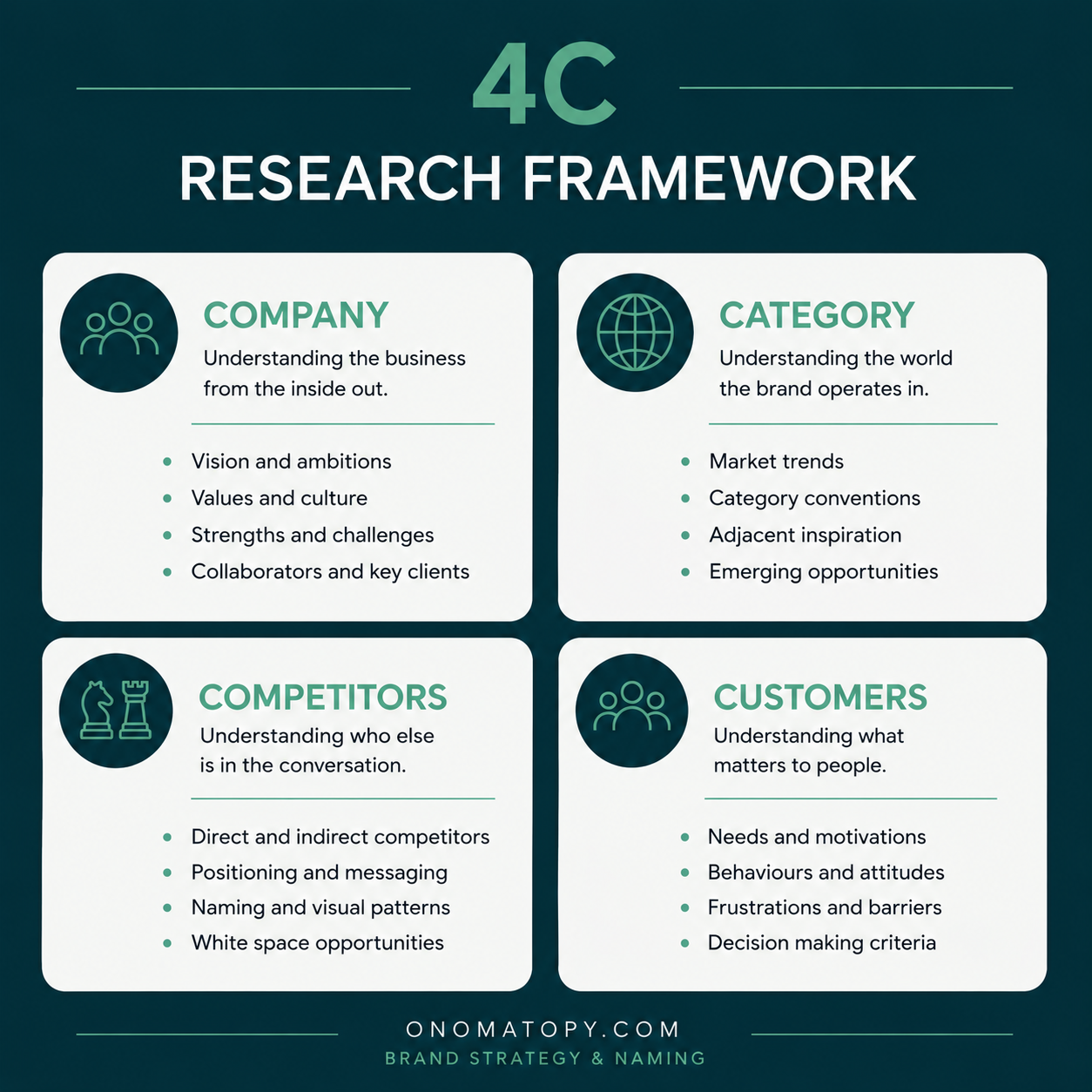
I start with a discovery session and a detailed questionnaire for the key people involved in the naming decision. I usually use the 4Cs framework to structure the research:
Company
What are you building? What makes the business distinctive? What should the name reflect, and what should it leave room for? Brand positioning should inform the naming work.
Customers
Who needs to remember, understand or choose the brand? Which markets does the brand target, and what is important to customers in each?
Competition
What names already exist in the category? What patterns have become predictable? Where is there room to be different? I analyse competitors’ names and the wider category to understand what to avoid and where there’s space for differentiation.
Context
What is happening in the category, culture, language and market that could influence the name?
2. NAMING BRIEF
I turn the discovery work into a naming brief – a document that summarises the project, market, audience and naming objectives. We also agree the naming criteria with all the decision makers: how the name needs to look, sound and behave.
Not every quality matters equally to every brand. Distinctiveness may be critical for one business, while pronunciation, credibility or openness may be the priorities for another.
The brief becomes the reference point for developing and evaluating names.
3. NAME DEVELOPMENT
Based on the brief, I explore the creative territories that make sense for the brand.
Depending on the project, this might include real words, invented names, compounds, altered words, metaphors, suggestive names or names built around sound. Explore more naming approaches in Brand Name Types.
I don’t believe a naming project needs thousands of names to be valuable. A long list can create the illusion of choice while making the decision harder. I would rather develop fewer, more considered names that have a solid reason to be there.
The first round helps test the territories and generate discussion. Feedback then shapes the next round, allowing the work to become more focused.
I screen as I go. I use Google and other readily available sources to eliminate names with obvious conflicts in the category early in the process. I also avoid the territories already associated with another business in the same space. The result is a list of names that meet the objectives and criteria in the brief, from which the strongest candidates can be screened.
4. SCREENING
I screen names throughout the process and apply more detailed checks as the shortlist develops. This includes:
🟢 Common use and obvious category conflicts
🟢 Preliminary trademark checks in relevant categories and markets
🟢 Domain availability and the wider online footprint
🟢 Pronunciation, spelling and unwanted meanings
🟢 Linguistic and cultural appropriateness in relevant markets
These checks are preliminary screening, not legal clearance. Full trademark searches and legal opinions should be carried out by a trademark professional.
5. PRESENT & SHORTLIST
The strongest candidates are presented with relevant background and rationale for each.
I use the naming criteria to structure the discussion and, where useful, a naming chart to compare candidates consistently. More on my naming chart and criteria in this article.
The chart doesn’t decide which name is right. Naming will always involve judgement. It only helps to make the decision more objective, giving everyone involved a common basis for discussion and arriving at a small group of options (usually 3 to 6).
6. LEGAL & DECISION
Once a shortlist is agreed, a trademark attorney can conduct a full legal search to assess the availability and potential risks associated with each name. This is a more precise assessment than the preliminary screening and can take several days to several weeks. The aim is to arrive at a name that is distinctive, right for the brand, realistic to use, and gives the team a strong sense of ownership and enthusiasm.
More articles and insights on LinkedIn.
Examples of names I created:
Wizerfi
Wizerfi is an invented name for a portable WiFi service designed to give travellers a simple way to stay connected and control roaming costs.
The name is a blend of “wizard” and “WiFi”. “Wizard” introduces an idea of magic and ease, reflecting the brief for a device that would feel almost effortless to carry and use. “WiFi” anchors the name in the product category and provides immediate recognition.
The two source words overlap in their /w/, /i/ and /z/ sounds, allowing them to be compressed into a short, pronounceable form. The result retains enough of the familiar to signal connectivity while introducing an unexpected element that gives the name more personality than a conventional technology name.
The brief also required a clean .com domain, which we secured for Wizerfi.
Pigmento
Pigmento was created for a London based painting and decorating company whose existing name no longer expressed the breadth of its expertise or its vision.
The name comes from “pigment”, the substance that gives colour to paint, with the Italian and Spanish influenced ending “o” giving it a more distinctive and brandable form. The linguistic reference is direct enough to establish a connection with painting and colour, while the altered form moves it away from a generic category description.
The name also provided a strong semantic territory for the identity. Pigment suggests colour, transformation and creative expression, which connected with the repositioning of the business and gave us a broader visual language to develop.
We renamed and rebranded the company, extending the idea of pigment into an identity built around colour, light, energy and movement.
Jazzery
Jazzery was created for an innovative food delivery service built around quality control and a more flexible approach to ordering food at work.
Rather than naming the category literally, we explored a sound based and associative route. “Jazz” brings associations of rhythm, energy, improvisation and variation. The suffix “-ery” creates the sense of a place or establishment, as in bakery, eatery or brewery.
Together, the elements create Jazzery, a name that sounds like a place associated with food while borrowing the energy and spontaneity of jazz.
The name therefore works through association rather than description.
This became the basis for the wider brand idea of an urban, lively kitchen that adapts to the rhythm of city life and gives office workers greater control over their food choices.