Naming and branding terms explained, with examples, our own point of view and expert perspectives. Work in progress. New entries are added regularly.
A
Acronym
An acronym is a name formed from the initial letters of several words and pronounced as one word, such as NASA or LEGO (originally from the Danish leg godt).
Acronyms can become powerful brands over time, but they rarely communicate meaning on their own. Most need years of investment before people remember what they stand for.
Examples
Alliteration
Alliteration is the repetition of the same initial sound across two or more words. It makes names easier to remember and often more enjoyable to say.
Examples
- Coca-Cola
- Best Buy
- PayPal
Arbitrary Name
An arbitrary name uses an existing word with no logical connection to the category. Because these names start with little meaning, they can become highly distinctive.
Examples
B
Brand
A brand is the collection of perceptions, memories, expectations and experiences people associate with a business, product or person. It exists in the minds of customers rather than inside a company’s marketing department. A logo, colour palette or advertising campaign can shape a brand, but none of them is the brand itself.
In practice
Every interaction contributes to your brand. People may forget your latest campaign, but they remember the enduring value you provided, what you consistently stand for and whether you delivered on your promises. A name is often the first building block of a brand, but its meaning grows through experience. A memorable name may spark attention, but only consistent delivery turns a name into a brand.
Expert perspectives
| Expert |
View |
| Jean-Noël Kapferer |
A brand is a system of meaning expressed consistently across identity, communication and experience. (The New Strategic Brand Management) |
| David Aaker |
A brand is a set of assets and liabilities linked to a name that add or subtract value. (Building Strong Brands) |
| Marty Neumeier |
A brand is a person’s gut feeling about a product, service or company. (The Brand Gap) |
| Byron Sharp |
Brands are memory structures that increase the likelihood of being noticed and bought. (How Brands Grow) |
| Denise Lee Yohn |
A brand is built through what a company says, does and consistently delivers. (What Great Brands Do) |
Brand Architecture
Brand architecture defines how brands within a company relate to one another. It determines whether everything is grouped under one master brand, whether products and services operate as independent brands or follow a hybrid approach. It also deals with how new services fit into the existing portfolio.
Well designed architecture makes future growth easier while avoiding confusion for customers.
Examples
Branded House
Google: Google Maps – Google Drive – Google Photos
House of Brands
Procter & Gamble: Tide – Gillette – Pantene – Pampers – Oral-B
Hybrid
Microsoft – Microsoft Windows – Microsoft Teams – Bing – Xbox
Brand Associations
Brand associations are the ideas, emotions, memories and attributes people connect with a brand. Some are deliberately created through positioning and communication. Others develop through customer experience.
The strongest brands reinforce the same associations consistently over many years.
Examples
Volvo → Safety
Disney → Magic
Patagonia → Sustainability
IKEA → Affordable Scandinavian design
Brand Equity
Brand equity is the value a brand creates beyond the functional value of its products or services. It explains why people willingly pay more, trust more and remain loyal.
Expert perspectives
| Expert |
View |
| David Aaker |
Equity comes from awareness, loyalty, quality and associations. |
| Kevin Lane Keller |
Equity lives in customer knowledge and response. |
| Byron Sharp |
Strong brands grow by increasing penetration rather than relying on loyalty alone. |
Brand Essence
Brand essence is the central idea that captures the heart of a brand. Unlike a positioning statement, it is usually expressed in just a few words and works as a strategic compass rather than a marketing slogan.
Examples
- Nike: authentic athletic performance
- BMW: driving pleasure
Brand Extension
A brand extension uses an existing brand name to launch a new product or service.
Some names are flexible enough to support future growth. Others become limiting because they describe only one product or category. This is why future proofing is one of our naming criteria.
Examples
- Apple Watch
- Google Maps
- Virgin Atlantic, Virgin Active, Virgin Money
Brand Identity
Brand identity is the collection of elements a company deliberately creates to express itself, including name, logo, typography, colour, messaging, tone of voice and visual language.
Identity is controlled by the business. Brand is created in people’s minds.
Example
Spotify: simple identity, distinctive green, consistent digital experience.
Expert perspectives
| Expert |
View |
| Kapferer |
Identity is the brand’s self portrait. |
| Aaker |
Identity provides direction and meaning. |
| Neumeier |
Identity should express strategic difference simply and consistently. |
Brand Positioning
Brand positioning is the distinctive place a brand aims to occupy in people’s minds relative to competitors. It has to explain why customers should choose you instead of someone else.
Positioning comes before naming. A name cannot compensate for unclear positioning. A great name doesn’t create positioning. It can express it, thus contributing to an initial “asymmetric advantage”.
Examples
- Tesla → associated with innovation
- Patagonia → associated with environmental responsibility
Expert perspectives
| Expert |
View |
| Ries & Trout |
Positioning is owning a place in the customer’s mind. |
| Aaker |
Positioning defines the value proposition and supports brand identity. |
| Kapferer |
Positioning expresses what makes the brand unique within its category. |
Brand Salience
Brand salience measures how easily a brand comes to mind in buying situations. Unlike awareness, salience focuses on being remembered at the right moment.
Byron Sharp argues that increasing mental availability across buying situations is one of the main drivers of brand growth.
Example: When someone thinks about coffee on the way to work, Starbucks may come to mind before independent cafés. That is salience.
Brand Strategy
Brand strategy is the long term plan for creating preference. It defines what your brand stands for, who it serves, how it differs from competitors and how every expression of the brand should reinforce that position.
A strong strategy guides decisions long after the logo has been designed. Without strategy, creative decisions become subjective. Naming, messaging and design all become stronger when they are rooted in a shared strategic direction. Strategy comes first. Story and messaging express strategy and gives it meaning.
Expert perspectives
| Expert |
View |
| David Aaker |
Strategy builds long term brand equity. |
| Jean-Noël Kapferer |
Strategy protects identity while supporting growth. |
| Marty Neumeier |
Strategy aligns business, design and customer experience. |
| Al Ries & Jack Trout |
Strategy begins by owning a position in the customer’s mind. |
C
Category Entry Points
Category Entry Points are the situations, needs or cues that trigger people to think about buying within a category. The concept was developed by the Ehrenberg-Bass Institute and popularised by Byron Sharp and Jenni Romaniuk.
Examples: Coffee
- I’m tired
- I’m driving
- I need a meeting place
Examples: Travel
- Summer holiday
- Weekend break
- Business trip
Examples: Insurance
- Buying a house
- Buying a car
- Starting a business
Growing brands increase the number of buying situations in which they come to mind. A memorable name supports this process but cannot replace it.
Clearance Search
A clearance search is the legal review carried out before deciding on a brand name. It checks whether similar trademarks already exist in relevant markets and product classes.
Preliminary screening helps eliminate obvious conflicts. A full legal clearance should always be completed before deciding on a final name.
Coined Name
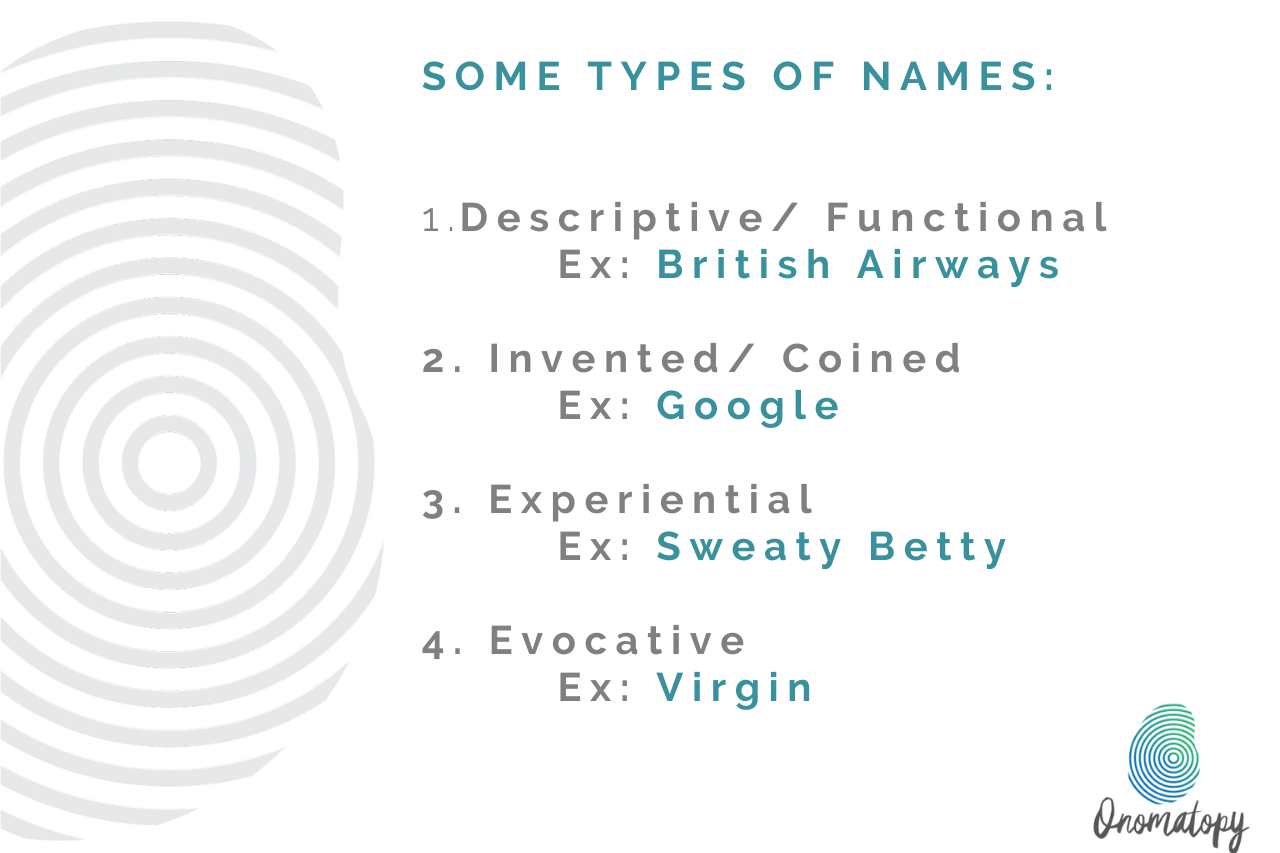
A coined name is a newly created word developed specifically for a brand. It may combine sounds, roots or linguistic patterns that did not previously exist as a word. More on name types in this article.
Examples
Cognitive Fluency
Cognitive fluency describes how easily people process information. Things that are easier to read, pronounce and recognise often feel more familiar and trustworthy.
Names that are difficult to pronounce or spell may require greater marketing investment before people become comfortable using them.
Examples
Zoom, Slack and Stripe are all short, familiar and easy to process.
Competitive Namescape
A competitive namescape is a map of the names used within a category. Rather than analysing products, it analyses language, identifying overused patterns, opportunities for differentiation, naming trends and crowded territories.
This is one of the first steps in most Onomatopy naming projects.
Connotation
Connotation refers to the indirect, emotional or cultural meaning associated with a word beyond its main dictionary definition. The same word can carry different connotations in different cultures.
Naming specialists evaluate both denotation and connotation during he naming process.
Example
Phoenix. Dictionary meaning: a mythical bird. Connotations: renewal, rebirth, transformation, resilience.
D
Denotation
Denotation is the literal dictionary meaning of a word. It differs from connotation, which concerns emotional or symbolic associations.
Example
Apple. Denotation: a fruit. Connotation: creativity, innovation, design, technology. The power of branding comes from expanding meaning beyond denotation.
Descriptive Name
A descriptive name explains exactly what a business or product does. Examples include General Motors, Booking.com and British Airways.
Descriptive names are immediately understood but are often harder to protect legally and more difficult to differentiate. Name types in this article.
Differentiation
Differentiation is the process of creating meaningful distinction from competitors. Names play a role, but differentiation also comes from positioning, experience, product and communication.
Traditionally, branding has emphasised finding a unique position in the market. Authors such as David Aaker, Al Ries and Jack Trout argue that brands should establish a clear point of difference that competitors cannot easily copy.
Byron Sharp offers a different view. In How Brands Grow, he argues that sustainable growth depends less on being radically different and more on building distinctive brand assets that make a brand easy to recognise and remember.
These ideas are complementary rather than contradictory. A business still needs a compelling value proposition, but customers often choose familiar brands because they are easier to notice and recall.
Examples
Patagonia differentiates through environmental activism. Apple combines product innovation with highly distinctive visual and verbal assets.
Expert perspectives
| Expert |
View |
| Al Ries & Jack Trout |
Own a unique position in the customer’s mind. |
| David Aaker |
Differentiate through meaningful brand associations and value. |
| Byron Sharp |
Focus less on uniqueness and more on building distinctive assets that improve recognition and mental availability. |
| Marty Neumeier |
Difference creates preference. Successful brands create clear meaning that people can recognise and remember. |
A strong name should support differentiation, but it works alongside consistent branding, customer experience and communication.
Distinctive Brand Assets
Distinctive Brand Assets are the recognisable cues people use to identify a brand without seeing its name. The concept was developed by Jenni Romaniuk and expanded within the Ehrenberg-Bass Institute.
Assets can include
- Name
- Logo
- Colour
- Shape
- Packaging
- Typeface
- Mascot
- Sonic identity
- Tagline
Examples
- The Nike Swoosh
- Tiffany Blue
- Netflix’s “ta dum”
- McDonald’s Golden Arches
- The Coca-Cola bottle shape
Expert perspectives
| Expert |
View |
| Jenni Romaniuk |
Distinctive assets improve recognition and memory. |
| Byron Sharp |
They strengthen mental availability. |
| Aaker |
They reinforce brand associations and equity. |
Common mistake: Confusing distinctive with different. A distinctive asset doesn’t need to be unique. It needs to be consistently recognised.
E
Experiential Name
An experiential name reflects what customers experience when using a product or service. Examples include Safari, Explorer and Navigator. These names are usually easier to understand than evocative names but often face greater competition for trademark registration.
Expertise
Expertise is recognised knowledge and judgement developed through experience and consistently demonstrated over time. Unlike credentials, expertise is validated by other people. It is what clients trust you to solve.
David C. Baker (The Business of Expertise) argues that expertise is created through increasing focus, not expanding services. Generalists compete on availability. Experts compete on judgement. The more clearly your expertise is defined, the easier it becomes for clients to understand why they should choose you.
Example
Compare these two introductions. “I do branding.” “I help founders create distinctive brand names that become strategic assets.” The second communicates expertise far more clearly.
F
Future Proof Naming
Future proof naming is the practice of choosing a name that allows a business to evolve without becoming restrictive.
Examples
Amazon no longer sells only books. Apple no longer makes only computers. Netflix no longer rents DVDs. Each name proved flexible enough to support expansion into new markets.
Common mistake: Choosing names such as London Office Supplies, Manchester Plumbing Services or Best Mortgage Brokers. These may communicate today’s business but limit tomorrow’s opportunities.
I
Initialism
An initialism is formed from the first letters of several words but pronounced letter by letter, unlike an acronym, which is spoken as a word.
Examples
Invented Name
An invented name is created specifically for a brand. Some are built from linguistic roots. Others are designed primarily for sound, rhythm and memorability.
Examples
Google, Oreo and Xerox illustrate different approaches to invented naming.
M
Memorability
Memorability refers to how easily people remember a name. Factors influencing memorability include pronunciation, rhythm, sound symbolism, familiarity, distinctiveness and repetition.
People rarely remember names because they are clever. They remember names because they are easy to recognise and repeatedly reinforced.
Mental Availability
Mental availability is the likelihood that buyers think of a brand in buying situations. According to Byron Sharp, growing brands are those that are easier to notice and easier to recall across many Category Entry Points.
Mental availability differs from awareness. People may know a brand exists but never think of it when making a purchase.
Naming contributes to mental availability through memorability, distinctiveness and repeated exposure. No name can create mental availability without consistent marketing and customer experience.
Example
Most people recognise dozens of bottled water brands. Only a handful come to mind when they are actually thirsty.
N
Naming Brief
A naming brief defines what a name needs to achieve. The better the brief, the better the names.
A good brief includes
- Positioning
- Audience
- Competitors
- Naming objectives
- Practical constraints
- Evaluation criteria
Naming Strategy
Naming strategy is the structured process of deciding what role a name should play within a broader brand strategy. It defines what the name should communicate, how different it should be, whether it should describe or suggest, and whether it needs to support future expansion.
A successful naming project starts with strategy rather than brainstorming.
Neologism
A neologism is a newly created word. Many successful brands eventually become accepted as ordinary words.
Examples
P
Personal Brand
A personal brand is the reputation and expectations people associate with someone. It develops through expertise, behaviour, communication and experience, whether intentionally managed or not.
Everyone has a personal brand. Not everyone develops it deliberately.
Visibility creates awareness. Expertise creates trust. Consistency builds reputation.
Examples
- Brené Brown
- Rory Sutherland
Expert perspectives
| Expert |
View |
| Tom Peters |
Every professional is the CEO of their own brand. (The Brand Called You) |
| Denise Lee Yohn |
Strong personal brands align values, behaviour and communication. |
| David C. Baker |
Expertise creates authority. Position yourself around what you want to become known for, not everything you can do. (The Business of Expertise, Secret Tradecraft of Elite Advisors) |
Phonaestheme
A phonaestheme is a recurring sound that people associate with a particular meaning. Brand naming often uses these subconscious sound associations.
Examples
- gl → light: glow, glitter, gleam
- sn → nose or mouth: sniff, snore, snout
Phonetics
Phonetics studies how speech sounds are produced and perceived. For naming specialists, phonetics helps evaluate pronunciation across languages and cultures.
Positioning Statement
A positioning statement summarises who the brand serves, what it offers and why it is different. Unlike a tagline, it is an internal strategic tool.
S
Sound Symbolism
Sound symbolism is the idea that speech sounds carry emotional or sensory associations. Words containing sharp consonants often feel faster or lighter than those containing rounded vowel sounds.
Sound symbolism influences perception before people understand meaning. It is one of the most overlooked aspects of brand naming. Source.
T
Trademark
A trademark protects the names, logos and other identifiers that distinguish one business from another. Registering a trademark gives the owner exclusive rights within specific product or service classes.
Trademark protection is one of the final and most important filters in any naming project. A name should never be chosen solely because the domain is available.
Trademark Screening
Trademark screening is an early search carried out before investing further in a potential name. It identifies obvious conflicts but does not replace a full legal clearance conducted by a trademark professional.
Tone of Voice
Tone of voice is the consistent way a brand communicates through language. It influences vocabulary, sentence structure and personality.
A distinctive tone makes a brand recognisable even when its logo is absent.
V
Verbability
Verbability describes a name’s ability to express dynamism and to become a verb. Verbable names often become deeply embedded in everyday language, although this can also create trademark challenges.
Examples
- Google it
- Uber home
- Photoshop the image
W
Word Mark
A word mark protects the words themselves rather than a logo or graphic treatment. This usually provides broader legal protection than registering only a visual logo.
Further Reading
- David Aaker, Building Strong Brands
- David Aaker, Aaker on Branding
- Jean-Noël Kapferer, The New Strategic Brand Management
- Byron Sharp, How Brands Grow
- Marty Neumeier, The Brand Gap
- Marty Neumeier, Zag
- Denise Lee Yohn, What Great Brands Do
- Al Ries & Jack Trout, Positioning
- Kevin Lane Keller, Strategic Brand Management
- Rob Meyerson, Brand Naming
- Alexandra Watkins, Hello, My Name Is Awesome
- Jenni Romaniuk, Building Distinctive Brand Assets
- David C. Baker, The Business of Expertise
- David C. Baker, Secret Tradecraft of Elite Advisors
- Tom Peters, The Brand Called You
- WIPO, Making a Mark
- UK Intellectual Property Office guidance
- EUIPO guidance